

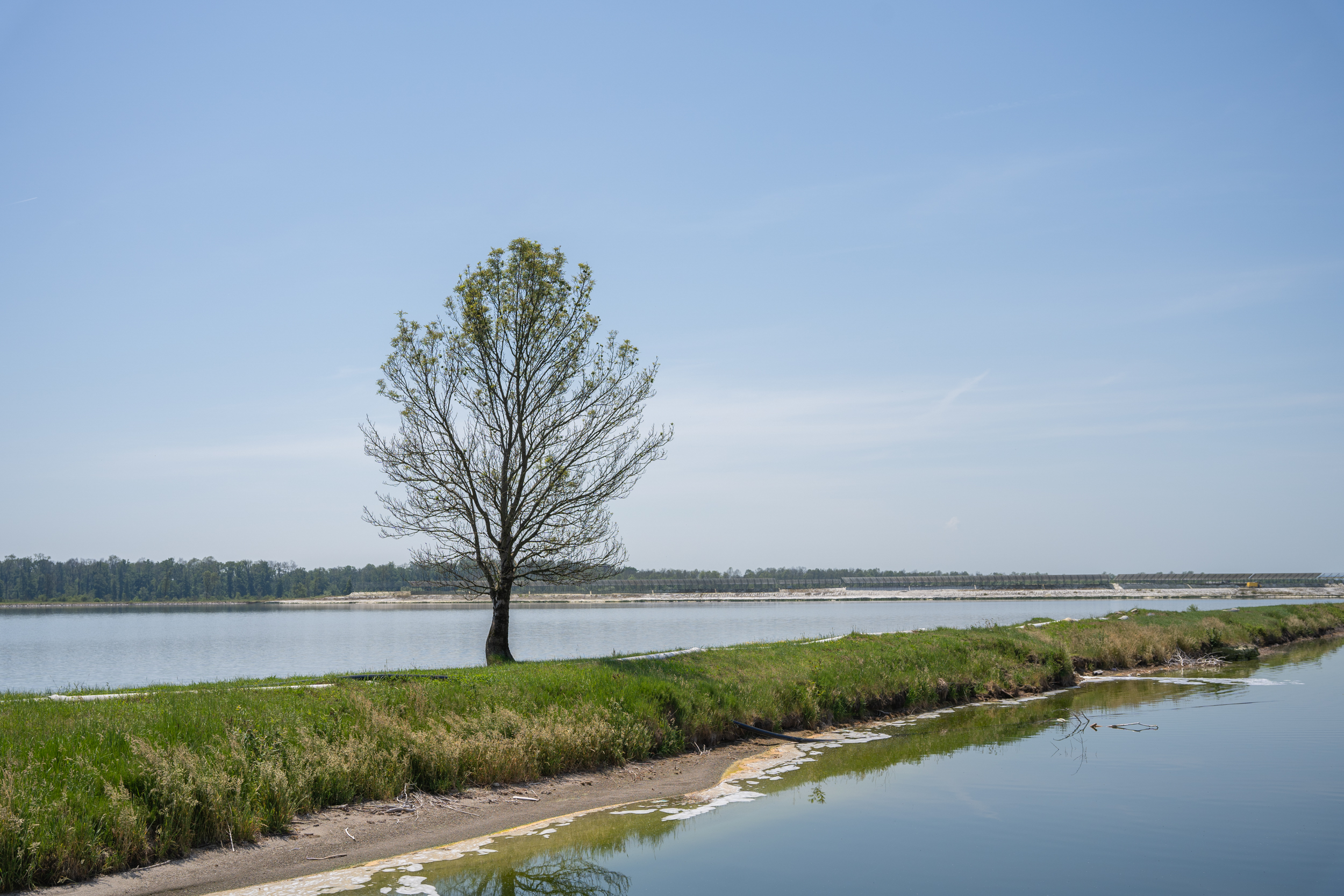
In this post, we bring together what 15 years of scientific research tells us about the phosphogypsum (PG) stack at Kutina — Croatia’s only legacy of this kind, and one of the lesser-known phosphogypsum deposits in Europe.
Between 1983 and 2009, the fertiliser company Petrokemija produced around 8.5 million tonnes of PG, piped as slurry to a disposal site some four kilometres south of the plant. The site consists of five ponds covering 1.7 km² and sits right at the edge of Lonjsko Polje Nature Park, a vast floodplain and ornithological reserve.
Since 2009 the stack has been inactive, and in 2019 it changed hands. But the questions it raises — about radioactivity, trace elements and what to do with the material — are very much alive.
Why this matters
The Kutina stack sits beside Lonjsko Polje Nature Park and not far from the town itself. For the people living around it, the questions are practical: are the air, water and soil safe now that production has stopped?
PG also sits at a regulatory crossroads. As a NORM material — Naturally Occurring Radioactive Material — it falls under radiation-protection and waste legislation, yet EU policy increasingly frames it as a potential resource rather than a liability.
That debate is shifting fast. Worldwide, only about 15% of PG is reused, but as coal plants close and gypsum supply tightens — and as PG turns out to hold elements the market actively wants — the question is moving from how to contain these deposits to how to valorise them safely, as project FIC-Fighters aims to do. In other words, it matters because we need to chart a course to shift the perspective: moving from viewing it as a liability that must be contained to finding a viable second life for most of its components.
What the researchers found
The clearest picture we have is radiological. Field campaigns measured the natural radionuclides — uranium, thorium, radium, lead-210 and potassium-40 — in the PG itself and in the soil and grass around it, and then modelled what that means for people and wildlife. The average annual effective dose estimated for workers at the site was about 0.4 mSv, in line with the global average dose people receive from natural background radiation every year. Modelling with the ERICA Assessment Tool indicated a limited radiological impact on the non-human biota of the neighbouring Lonjsko Polje wetland.
However Radium-226, the radionuclide of most concern, is not evenly distributed: concentrations span a wide range, and a small fraction — around 5% of the material —becomes highly radioactive. That minor but more active fraction is precisely what any future handling or reuse would need to manage with care.
The most recent research added a biological dimension. Using honey bees as living samplers around the Kutina site, scientists found that most of the trace elements detected on the bees were carried as surface dust rather than absorbed into the organism. The result is encouraging — it points to limited biological uptake — and it also validates a cheap, repeatable way to keep watching the site over time.
However, reviews of the evidence are blunt about the gaps: data on heavy metals and rare earth elements in Kutina PG remain scarce, and several potentially hazardous substances have simply never been measured.
Finally, other work showed that Kutina PG can be incorporated into building materials, and that the surface of the disposal site itself can be stabilised and revegetated using another industrial residue as a cover.
How the work was carried out
Radiological studies relied on gamma spectrometry to measure activity concentrations of 238U, 235U, 232Th, 226Ra, 210Pb and 40K in samples of phosphogypsum, soil and grass. To estimate effects on non-human biota, researchers used the ERICA Assessment Tool, a standard model for environmental radiation dose.
A 2013 study went further, developing a new method to trace how far PG particles spread from the deposition site into the surrounding environment.
The honey-bee research combined two scenarios. In the field, hives were placed at the Kutina stack and at two control sites 6 and 14 km away. In the laboratory, bees were exposed to PG concentrations from 0 to 1600 mg/L. Across both, 22 elements and a set of physiological biomarkers were analysed to separate genuine exposure from harmless dust.
What it means for the academia and local communities
For the scientific community, Kutina is a well-characterised case on the radiological side but an open question on the chemical one — a clear invitation for further study.
For local communities, the findings offer measured reassurance rather than alarm — and tools, such as bee biomonitoring, that make ongoing oversight cheaper and more transparent.
Want to know more?
You can read the full articles via the links below, where they are available for consultation and discussion.
Join the conversation, explore related documents, and help us rethink how Europe manages the legacy of phosphogypsum.
References
- Bituh, T., Marović, G., Franić, Z., Senčar, J., & Bronzović, M. (2009). Radioactive contamination in Croatia by phosphate fertilizer production. Journal of Hazardous Materials, 162(2–3), 1199–1203.
- Leaković, S., Lisac, H., & Vukadin, R. (2012). Primjena industrijskog otpada CaF₂ u procesu ozelenjivanja odlagališta fosfogipsa [Application of the industrial waste CaF₂ for vegetative covering of a phosphogypsum disposal site]. Kemija u industriji, 61(11–12), 505–512.
- Bituh, T., Marović, G., Petrinec, B., Prlić, I., & Vučić, Z. (2013). Natural radioactivity in the phosphogypsum deposition site surrounding environment. In Proceedings of the 9th Symposium of the Croatian Radiation Protection Association.
- Bituh, T., Vučić, Z., Marović, G., & Prlić, I. (2013). A new approach to determine the phosphogypsum spread from the deposition site into the environment. Journal of Hazardous Materials, 261, 584–592.
- Franković Mihelj, N., Ukrainczyk, N., Leaković, S., & Šipušić, J. (2013). Waste phosphogypsum — toward sustainable reuse in calcium sulfoaluminate cement based building materials. Chemical and Biochemical Engineering Quarterly, 27(2), 219–226.
- Bituh, T., Petrinec, B., Skoko, B., Vučić, Z., & Marović, G. (2015). Measuring and modelling the radiological impact of a phosphogypsum deposition site on the surrounding environment. Arhiv za higijenu rada i toksikologiju, 66(1), 31–40.
- Bituh, T., Petrinec, B., Skoko, B., Babić, D., & Rašeta, D. (2021). Phosphogypsum and its potential use in Croatia: challenges and opportunities. Arhiv za higijenu rada i toksikologiju, 72(2), 93–100.
- Glavan, G., Lazarus, M., Bituh, T., Sekovanić, A., Petrinec, B., Haneklaus, N., & Filipi, J. (2026). Physiological markers and trace elements in honey bees residing phosphogypsum deposition site: Field and laboratory scenario. Ecotoxicology and Environmental Safety, 315, 120112.