

Intro
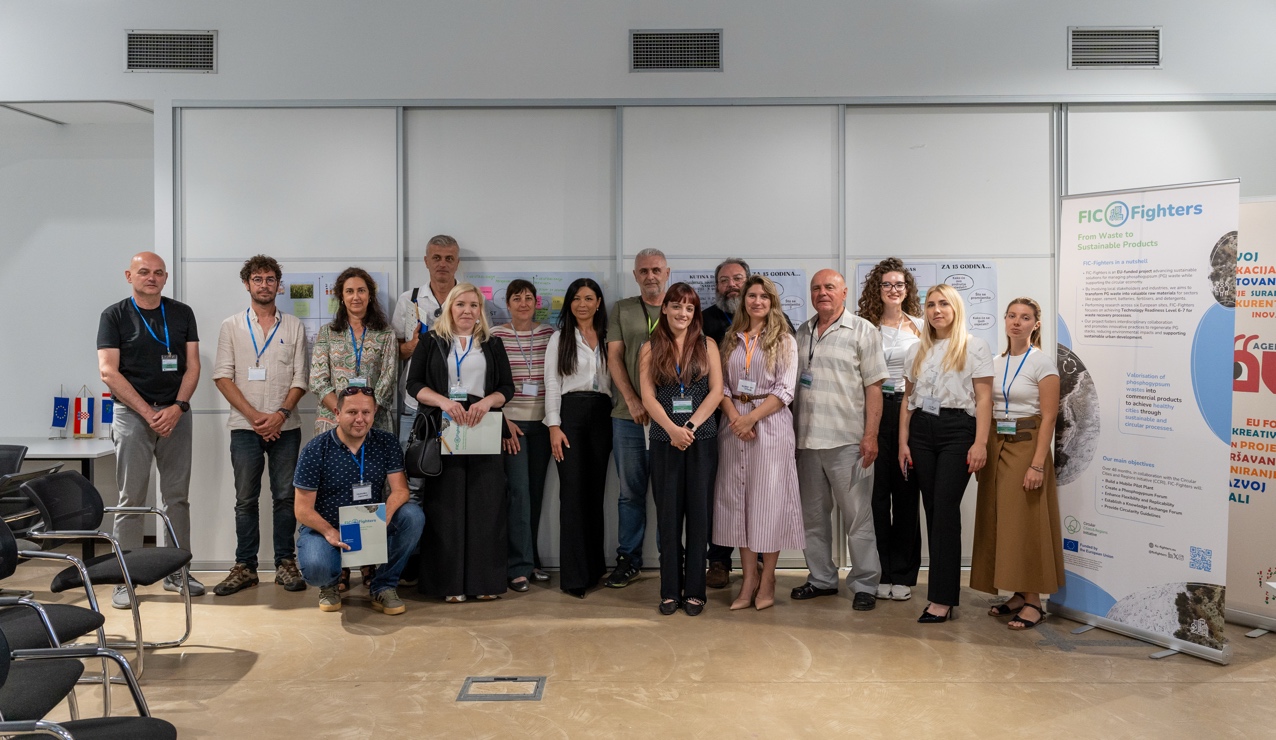
On 26 May 2026, citizens and representatives of public bodies and research organisations gathered in Kutina, Croatia, for the citizen workshop “Voices for change: exploring solutions for the Kutina stack”. Kutina has a unique relationship with phosphogypsum. For many residents, the history of the stack is inseparable from the history of Petrokemija, the industrial complex that helped shape the city’s economy and identity. Through a participatory discussion and future-oriented exercises, participants reflected on this legacy, explored current challenges, and imagined pathways towards new solutions for the PG stack.
Context
Located in central Croatia, Kutina developed around its fertiliser industry, which provided employment and economic growth for generations. Alongside these benefits, industrial activity also produced phosphogypsum, which has accumulated over decades and remains part of the local landscape today. The stack lies next to the Lonjsko Polje Nature Park, a Ramsar wetland of international importance and a protected bird habitat.
For many participants, the PG stack symbolises a dual reality. On one hand, it represents economic development, jobs, and agricultural productivity. On the other, it raises concerns about current and long-term environmental impacts, and the responsibilities of different agents involved in its management and oversight.
The Workshop
The event was organised by the local partner PREHNIT, with the support of ALDA and At Clave. The workshop combined presentations about the project with two participatory activities. In the first exercise, participants mapped positive and negative impacts associated with PG and the industrial development of Kutina. They reflected on changes over time, discussing both historical experiences and current realities.
The second exercise invited participants to imagine the future. Working collaboratively, they created newspaper-style stories describing what Kutina could look like in 10–15 years if sustainable solutions for PG management were successfully implemented.
Throughout the discussions, participants showed a high level of engagement, openly shared their knowledge and experience, and built on each other’s ideas.
Insights from the discussion
During the workshop, participants discussed the industrial heritage and local identity, and relevant areas of impacts and concerns. Participants described the fertiliser industry as both a source of prosperity and a source of environmental challenges. They recalled the approximately 4,000 jobs it created, the high-quality mineral fertilisers that increased crop yields, and its strong export performance.
On the other hand, they expressed concerns regarding the surrounding environment, especially focusing on air, soil and water pollution caused by inadequate environmental protection measures. The potential threat to the Sava River basin and the Lonjsko Polje Nature Park, home to one of the largest common carp spawning areas in Europe, was voted the most urgent issue to address. Participants also pointed to the high acidity of the stack (pH below 2) as a threat to biodiversity, particularly bird populations.
Another key topic that emerged was the governance and institutional responsibility. Participants called for stronger involvement of national-level authorities and noted that the local community, as well as some institutions, are not sufficiently informed about the projects and activities addressing the stack. They also considered that existing regulations are not strict enough for this type of industry and waste.
At the same time, participants acknowledged positive developments in recent years: acidity levels have been reduced, the neutralisation process has continued under private ownership, the EU has played a positive role through legislation and projects, and a photovoltaic power plant is planned on the site.
Download the full workshop report here
Looking Ahead
The future scenarios developed during the workshop shared a common vision: transforming phosphogypsum from a waste legacy into a valuable resource.
Participants imagined Kutina becoming a city of new and cleaner technologies, circular economy solutions and industry. They created hypothetical future newspaper headlines, and those described PG as a sought-after resource used in various industrial processes, creating new jobs in the construction, chemical and manufacturing sectors. One group foresaw neutralising 80 to 100% of the stack’s acidity within 15 years, revegetating around 200 hectares (today only about 2% of the site is green) and building a large-scale solar power plant inspired by examples from Belgium.
Underlying all these visions was a common message: successful transformation will require long-term, transparent cooperation between industry, researchers, public authorities, and citizens.
This citizen event demonstrates the importance of combining technical innovation with community dialogue. Local knowledge, lived experience, and stakeholder engagement are essential ingredients for designing sustainable solutions for phosphogypsum management and regional regeneration. Participants themselves asked for broader involvement of local residents in future activities, so that citizens can help shape the future of Kutina.